Popular
Searches:
Popular
Searches:
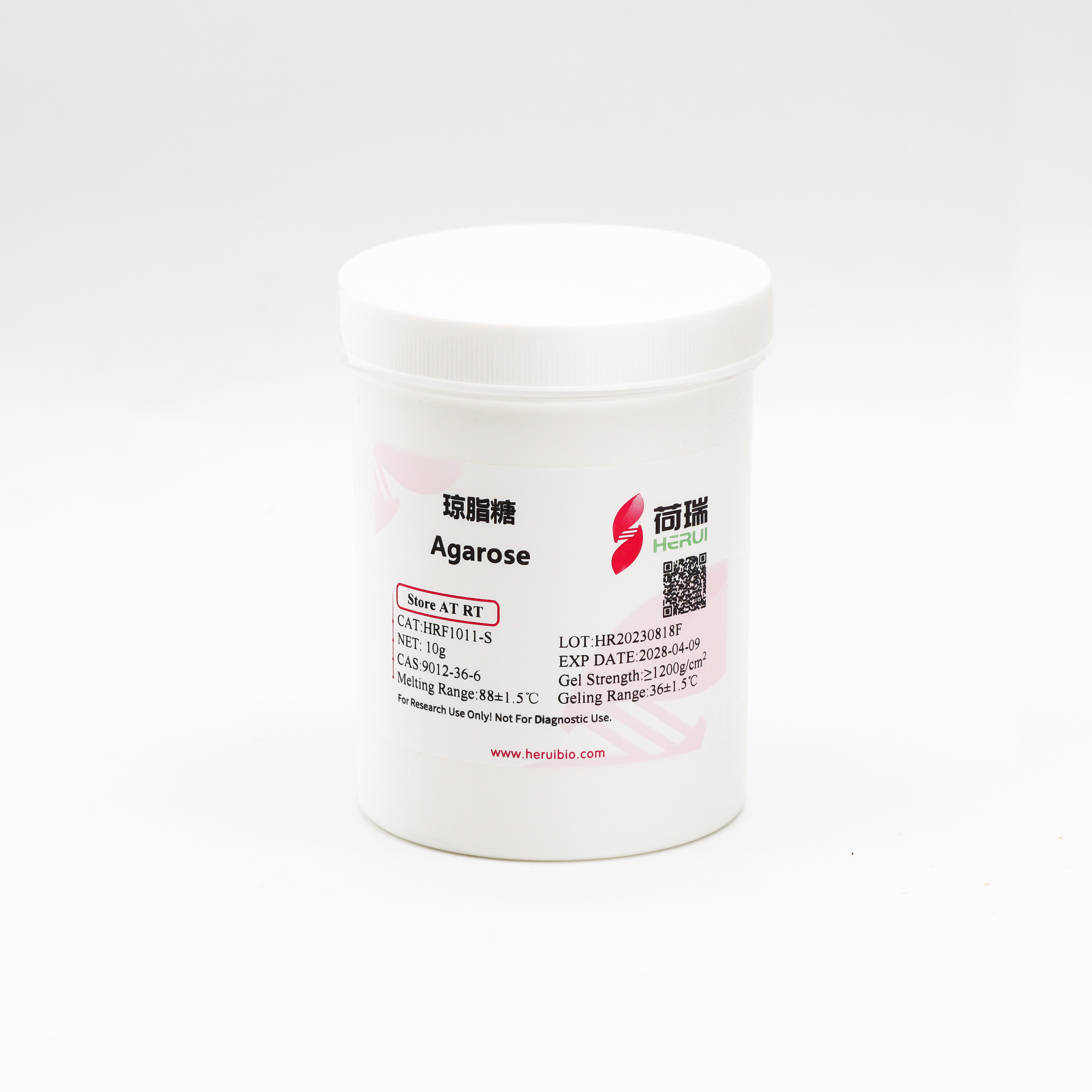
Agarose
Price:
¥219
Cargo Number:
HRF1011
Specification:
100g 500g
Specification and quality control:
Product Details
Product Specification
Product Information
Product Name | Product Number | Specification |
Agarose | HRF1011 | 100 g |
Agarose | HRF1012 | 500 g |
Product Description
Agarose is a purified linear galactan hydrophilic colloid extracted from agar or agar-containing seaweed. It is a linear polymer composed of β-D-galactopyranose (1-4) linked to 3,6-anhydro α-L-galactopyranose. As a gelling agent, it is commonly used for routine nucleic acid analysis by gel electrophoresis or blotting (such as Northern or Southern), and is also suitable for protein applications, such as radial immunodiffusion (RID) experiments.
The basic parameters of agarose include:
1) Sulfate content - an indicator of purity, because sulfate is the main ionic group in agarose;
2) Gel strength - the external force applied to the gel to break it;
3) Gel point - the temperature at which a water-soluble agarose solution forms a gel after cooling. In the process of liquid to gel transformation, agarose solution has hysteresis, so the gelation point is not equivalent to the melting point of gel;
4) Electroosmosis (EEO) - an electric movement of liquid penetrating gel. Anionic groups in agarose gel adsorbed on the matrix will not migrate, but dissociated cations will migrate toward the negative electrode, thus generating electroosmosis. Since the electrophoretic migration of biopolymers usually moves toward the negative electrode, the internal convection generated by EEO will interfere with the separation efficiency.
Product Nature
CAS No. | 9012-36-6 |
Appearance | White to off-white powder |
Gel Strength (1.0%) | ≥1200 (g/cm2) |
Geling Range ( 1.5%) | 36±1.5℃ |
Melting Temperature Range (Melting Range, 1.5%) | 88±1.5℃ |
Electroosmotic value (EEO, -mr) | ≤0.13 |
Sulfate (%) | ≤0.15% |
Moisture | ≤10% |
DNase | None Detected |
RNase | None Detected |
Protease | None Detected |
Transportation and storage methods
It can be transported and stored at room temperature. Valid for 5 years.
Operation process:
1. Gel Preparation Method
1. Prepare an appropriate amount of buffer for electrophoresis and gel preparation. Prepare an appropriate concentration of buffer for electrophoresis and gel preparation according to the needs of electrophoresis.
Note: The buffer used for electrophoresis and the buffer used for gel casting must be the same.
2. According to the amount of gel and gel concentration, add accurately weighed agarose powder into a conical flask with a certain amount of electrophoresis buffer (the total liquid volume should not exceed 50% of the capacity of the conical flask).
2. Heat the agarose in a microwave oven and heat it to boiling on high. Keep the gel boiling for about 30 seconds. Wear heat-resistant gloves, remove the conical flask, shake the conical flask carefully, resuspend the undissolved particles, and heat it again on high heat for 1-2 minutes, or until the agarose is completely dissolved. Please wear heat-resistant gloves and shake the conical flask carefully to make the agarose gel solution fully uniform.
Note: It is necessary to ensure that the agarose is fully dissolved and the agarose gel is clear. Otherwise, the electrophoresis image will be blurred.
If the glue solution boils and bubbles violently during heating, stop heating. The heating time in the microwave should not be too long.
4. Allow the solution to cool to about 60°C. If necessary, add ethidium bromide (EB) solution to a final concentration of 0.5ug/ml.
And mix thoroughly.
Note: Ethidium bromide is a carcinogen. Wear gloves when working with solutions containing ethidium bromide.
5. Pour the agarose solution into the gel mold and insert the comb at the appropriate position. The thickness of the gel is generally between 3-5mm.
6. Allow the gel to solidify at room temperature (approximately 30 minutes to 1 hour), and then place it in an electrophoresis tank for electrophoresis.
Note: If the gel is not used immediately, please wrap it with plastic wrap and store it at 4°C. It can generally be stored for 2 to 5 days.
Agarose concentration and DNA separation range
Agarose concentration (%) | 0.3 | 0.6 | 0.7 | 0.9 | 1.2 | 1.5 | 2.0 |
Linear DNA size (kb) | 60-5 | 20-1 | 10-0.8 | 7-0.5 | 6-0.4 | 4-0.2 | 3-0.1 |
Precautions
1) You can use boiling or microwave heating to melt the agarose. The agarose must be melted thoroughly. Melting the agarose may cause violent boiling, so be careful to prevent burns.
2) For your safety and health, please wear a lab coat and disposable gloves when operating.
3) This product is for scientific research purposes only!