Popular
Searches:
Popular
Searches:
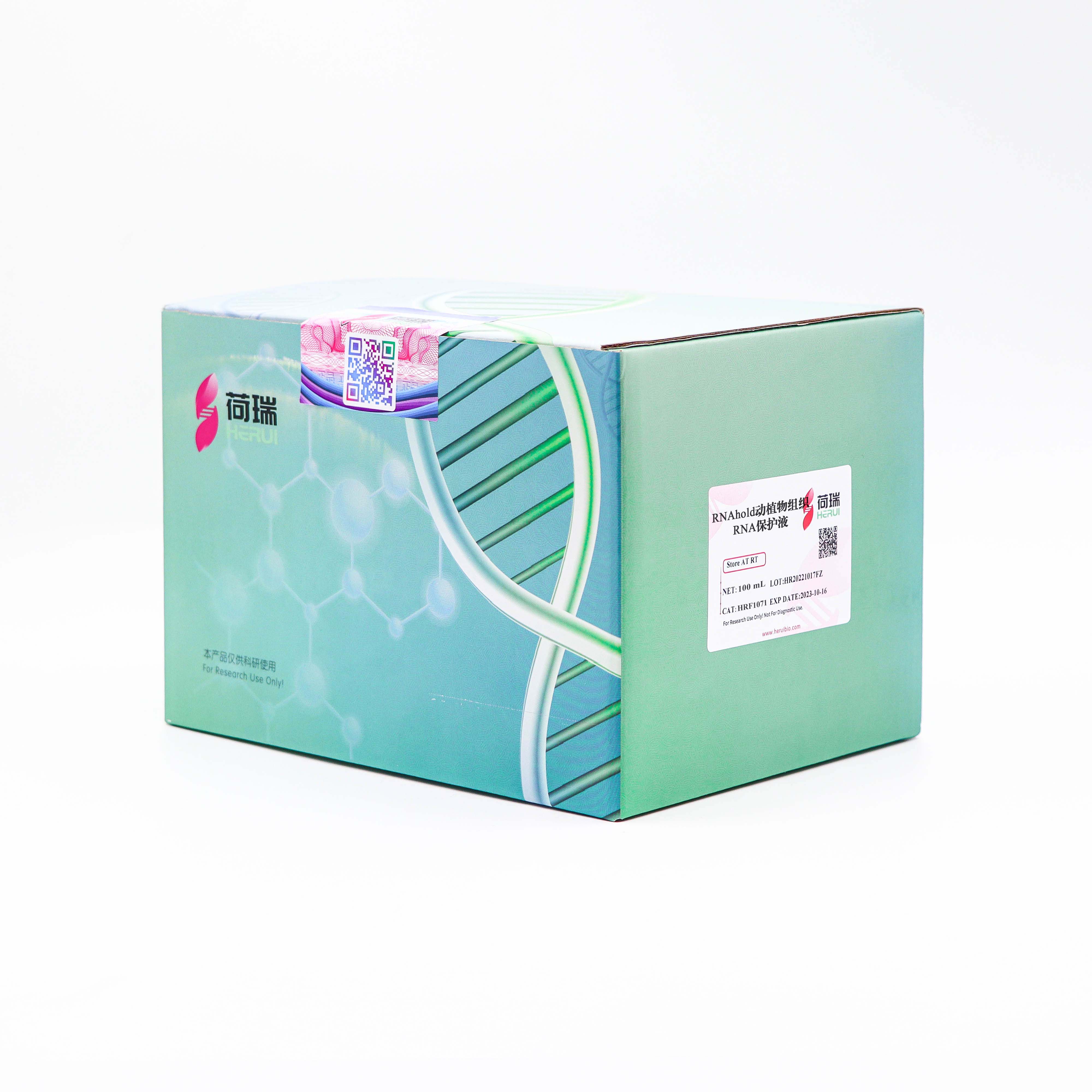
RNAlater Animal and plant Tissue RNA Stabilizer RNAlater Tissue Stabilizer
Price:
¥457
Cargo Number:
HRF1071
Specification:
100mL
Specification and quality control:
Product Details
Product Specification
Product Information
Product Name | Product Number | Specification | Price (Yuan) |
RNAhold RNA Stabilizer RNA protection solution | HRF1071 | 100 mL | 457.00 |
Product Description
RNases are widely present in the environment and can easily degrade RNA in freshly collected samples of animal and plant tissues, blood, body fluids, etc., requiring researchers to quickly freeze fresh samples in liquid nitrogen or immediately purify RNA after collecting them, which brings many inconveniences to researchers' outdoor work.
RNA Stabilizer is specially developed to stabilize and protect RNA in collected samples. As a non-toxic solution, it can quickly penetrate into tissues and inactivate endogenous RNase.
Features
The operation is extremely simple: just cut the fresh tissue into tissue blocks of appropriate size (≤0.5 cm) and immerse them in 5~10 times the volume of RNAhold.
Long stability period: Tissues/cells infiltrated with RNAhold can be stored at 37°C for 1 day, at room temperature for 1 week, at 4°C for 4 weeks, and at -20°C/-80°C for a long time.
Wide downstream compatibility: Compatible with almost all RNA isolation methods, such as HRbio™ Total RNA Extraction Reagent , and almost all
Some commercial RNA extraction kits include centrifugal column extraction method, magnetic bead purification method, etc.
The material has a wide range of applications: it can be used to preserve a variety of animal and plant tissues (such as brain, heart, liver, pancreas, kidney, spleen, testicles, muscles, plant stems and leaves, etc.), and can also be used for yeast, tissue culture cells, etc.
Operation process
1. Sample processing
A. Animal tissue: RNAhold Stabilizing Solution will not destroy the integrity of animal tissue structure.
Processing procedure: Cut the tissue into appropriate size ( ≤0.5 cm ), then add 5 times volume of RNAhold.
Note: After the tissue immersed in RNAhold has been equilibrated for a period of time, it can be removed from the solution, cut into smaller tissue pieces ( ≤0.5 cm in size ), and then put back into RNAhold.
Note: Some tissues (such as bones) have relatively weak liquid permeability and are not suitable for RNA protection using this product.
B. Plant tissue: This product can directly penetrate soft plant tissues (such as young leaves and stems) and achieve ideal RNA protection effects.
Processing process: After cutting the tissue into appropriate size ( ≤0.5 cm ), add 5 times the volume of RNAhold stabilizing solution.
Note: Some plant tissues have natural barriers (such as the wax layer on the surface of leaves) that can hinder the penetration of RNAhold. For such tissues, it is often necessary to destroy these barriers to allow the solution to penetrate.
C. Tissue culture cells, leukocytes, etc.: Collect cell pellets according to standard experimental procedures (wash 1-2 times with PBS), and then add 5-10 times the volume of RNAhold.
D. Yeast: Centrifuge and discard the supernatant, collect about 10 8 cells (12,000g, 2 min), and add 0.5-1 mL RNAsafe.
Long-term storage : Place in RNAhold at 4°C for 1 hour. Then centrifuge and discard the supernatant, collect the yeast cells (12,000g, 5 min), and store at -80°C.
2. Sample Storage
A. -80℃ storage: Samples are frozen and stored. For archived samples, -80℃ storage is recommended. Under this storage condition, samples can be stored for a long time and the protection effect is the best.
Operation process: The samples were soaked overnight at 4℃ and then transferred to -80℃.
If the sample needs to be thawed in the middle, it is recommended to take out the tissue soaked overnight at 4℃ or collect the cells by centrifugation, and then freeze them at -80℃. When extracting RNA from the sample protected by RNAhold, it can be directly thawed at room temperature and then refrozen without causing serious loss of RNA amount or obvious damage to RNA integrity.
B. -20℃ storage: also applicable to the storage of archived samples. Samples will not freeze at -20℃, but may form crystals. Under this storage condition, samples can be stored for a long time without affecting subsequent RNA isolation.
Operation process: The sample is soaked overnight at 4℃, and then transferred to -20℃. When extracting RNA from the sample protected by RNAhold, it can be directly thawed at room temperature and then refrozen without causing serious loss of RNA quantity or obvious damage to RNA integrity.
C. Storage at 4℃: Most samples can be stored in RNAhold for 1 month without significant RNA degradation .
D. 25℃ (room temperature) storage: It is recommended to store at low temperature. If conditions do not allow, please cool the RNAhold stabilization solution on ice for a few hours, then immerse the sample in this solution and store it stably at room temperature for 1 week without obvious RNA degradation.
E. 37℃ storage: The purified RNA sample is incubated at 37℃ for 24 hours, and the structure remains intact.
3. RNA Extraction
Since the process of RNAhold inactivating RNase is reversible, be sure not to wash away RNAhold before using the protected sample .
A. Tissue samples: Use sterile forceps to remove , then use clean absorbent paper to remove the surface liquid. Immediately place in lysis buffer for homogenization.
B: Cell samples: Due to the high density of RNAhold, a centrifugal force greater than that of ordinary media is required. Generally speaking, cells stored in RNAhold can withstand higher speeds and maintain cell integrity. Most cells can be collected by centrifugation at 5,000g for 5 min.
Note: Since different cells have different tolerance to centrifugal force, it is recommended to first test the centrifugal speed tolerance using a small amount of cells.
C. Extract RNA: Follow the RNA extraction protocol.
Transportation and storage methods
Transported and stored at room temperature , valid for 5 years.
Precautions
1. Samples treated with RNAhold can also be used for genomic DNA extraction and even protein extraction. However, since RNAhold denatures proteins, it is not suitable for the extraction of natural proteins.
2. Some precipitation may occur during the storage of RNAhold at room temperature. Before use, just incubate it at 37℃ for a while and shake it intermittently to re-dissolve. It will not affect the use.
3. This RNAhold is only suitable for fresh tissues and cannot be used for frozen tissues.
4. For your safety and health, please wear a lab coat and disposable gloves when operating.
5. This product is for scientific research purposes only!