
Popular
Searches:
Popular
Searches:
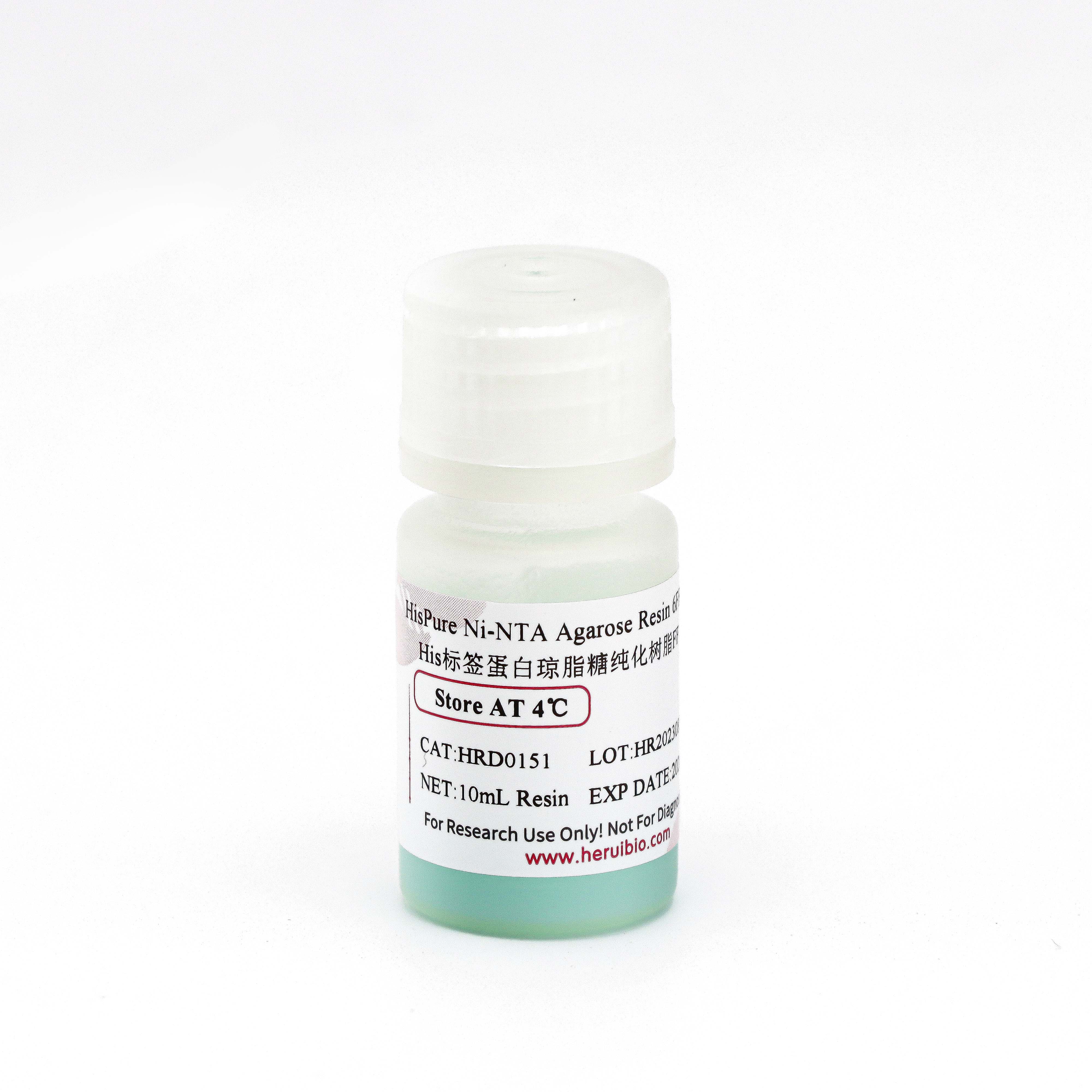
HisPure Ni-NTA Agarose Resin 6FF (His Label protein agarose Resin FF)
Price:
¥730
Cargo Number:
HRD0151
Specification:
10mL 25mL 50mL 100mL 1000mL
Specification and quality control:
Product Details
Product Specification
Product Information
Product Name | Product Number | Specification | store |
HisPure Ni-NTA Agarose Resin 6FF (His-tag protein agarose purification resin FF) | HRD0151 | 10 mL | 4℃ |
HisPure Ni-NTA Agarose Resin 6FF (His-tag protein agarose purification resin FF) | HRD0152 | 25mL | 4℃ |
HisPure Ni-NTA Agarose Resin 6FF (His-tag protein agarose purification resin FF) | HRD0153 | 50 mL | 4℃ |
HisPure Ni-NTA Agarose Resin 6FF (His-tag protein agarose purification resin FF) | HRD0154 | 100 mL | 4℃ |
HisPure Ni-NTA Agarose Resin 6FF (His-tag protein agarose purification resin FF) | HRD0154X | 1000 mL | 4℃ |
Product Description
HisPure Ni-NTA Agarose Resin 6FF is a 6% highly cross-linked agarose microsphere , which is covalently coupled to a chelating agent and binds Ni 2+ through four coordination bonds . It is used for high-affinity purification of polyhistidine-tagged recombinant proteins. HisPure Ni-NTA Agarose Resin 6FF has low Ni 2+ leakage, high binding capacity and good chemical stability. It is compatible with various additives used in protein purification . In addition, due to the pressure resistance of its matrix (can withstand a pressure of up to 0.3 MPa), this product can be used for industrial large-scale protein purification, and can achieve purification of target proteins at relatively high flow rates.
Product Nature
Matrix | Highly cross-linked 6% agarose gel |
Particle size | 90μm (45-165μm) |
Loading capacity | >50 mg 6×His-tagged protein/mL precipitation matrix |
Pressure resistance | 0.3 MPa, 3 bar |
Storage buffer | 1× PBS containing 20% ethanol |
Transportation and storage methods
Transport with ice packs. Store at 4℃. Valid for 2 years.
Precautions
1) For your safety and health, please wear a lab coat and disposable gloves when operating.
2) This product is for scientific research purposes only!
How to use
1. Purification process
1. Buffer Preparation
Principle of buffer usage : low imidazole loading, high imidazole elution, or high pH loading, low pH elution. Buffer should be sterilized by filtration with a 0.22 m or 0.45 m filter membrane before use. The formula required for purification of soluble histidine-tagged proteins is detailed in Appendix 2. The buffer and formula required for purification of inclusion body histidine-tagged proteins are detailed in Appendix 3.
2. Sample preparation
2.1 Proteins expressed in bacteria (this description takes purification of proteins expressed in bacteria as an example)
1) Pick a single colony into LB medium containing suitable resistance, and add the corresponding inducer for the corresponding time according to the vector instructions.
2) After the expression is completed, transfer the culture medium to a centrifuge bottle, centrifuge at 7000 rpm for 15 min, collect the bacteria, and then add 1/10 volume of lysis buffer and PMSF (PMSF is added before crushing, and its final concentration is 1 mM). Other protease inhibitors can also be added, but they cannot affect the binding of the target protein to the resin.
3) Then add lysozyme to a working concentration of 1 mg/mL.
Note: If the host cell used for expression contains pLysS or pLysE, lysozyme may not be added.
4) Resuspend the bacterial pellet (if the bacterial solution concentration is high, consider adding 10 g/mL RNase A and 5 g/mL DNase I), mix well, and place on ice to ultrasonically disrupt the cells until the bacterial solution remains basically clear.
5) Collect the clarified protein solution into a centrifuge tube and centrifuge at 10,000 rpm and 4°C for 20-30 min. Take the supernatant and place it on ice for later use or store it at -20°C.
2.2 Soluble proteins secreted and expressed in yeast, insect and mammalian cells
Transfer the cell culture medium to a centrifuge bottle, centrifuge at 5000 rpm for 10 min, and collect the supernatant. If the supernatant does not contain EDTA, histidine, and reducing agents, it can be directly purified on the column; if it contains EDTA, histidine, and reducing agents, it needs to be dialyzed with 1×PBS at 4°C before being applied to the column.
Note: For large volumes of supernatant, ammonium sulfate needs to be added for precipitation and concentration, and then dialyzed against 1× PBS at 4°C before loading onto the column.
2.3 Inclusion body protein purification (taking bacteria as an example)
1) Transfer the culture medium to a centrifuge bottle, centrifuge at 7000 rpm for 15 min, collect the bacteria and discard the supernatant.
2) Suspend the cells thoroughly at a ratio of cells to lysis buffer = 1:10 (w/v), mix well, and disrupt by ultrasonication on ice.
3) Transfer the broken liquid to a centrifuge tube, centrifuge at 10,000 rpm, 4°C for 20-30 min, and discard the supernatant. Repeat steps 2) and 3) once.
4) Suspend the inclusion bodies fully at a ratio of 1:10 (w/v) of cells to lysis buffer (containing 8 M urea).
5) Purification of His-tagged proteins under denaturing conditions.
3. Column Packing
1) Rinse the sieve plate and joints at the bottom of the chromatography column with deionized water, ensure that there are no bubbles on the sieve plate at the bottom of the column, close the outlet at the bottom of the column, and leave 1-2 cm of deionized water at the bottom of the column.
2) Suspend the resin and carefully pour the slurry into the chromatography column continuously. Use a glass rod to pour the slurry along the column wall to reduce the generation of bubbles.
3) If a reservoir is used, immediately fill the column and reservoir with water, place the injection distributor on the surface of the slurry, and connect it to the pump, avoiding the formation of bubbles in the distributor or injection tube.
4) Open the outlet at the bottom of the column, turn on the pump, and run it at the set flow rate. Initially, the buffer should flow slowly through the column, and then slowly increase to the final flow rate, so as to avoid the impact of hydraulic pressure on the formed column bed and avoid uneven formation of the column bed. If the recommended pressure or flow rate cannot be achieved, the maximum flow rate of the pump used can be used, which can also achieve a better filling effect. When the column bed height is stable, add at least 3 column volumes of deionized water at the final column filling flow rate. Mark the column bed height. Note: In subsequent chromatographic procedures, do not exceed 75% of the maximum column filling flow rate.
5) Turn off the pump and close the chromatography column outlet.
6) If using a reservoir, remove the reservoir and place the dispenser in the chromatography column.
7) Push the distributor toward the column to the marked column bed height. Allow the column liquid to enter the distributor and lock the distributor joint.
8) Connect the packed column to the pump or chromatography system and start equilibration. If necessary, readjust the distributor.
4. Sample Purification
After the column is loaded, various conventional medium-pressure chromatography systems can be used. The following is an example of using AKTA:
1) Fill the pump pipe with deionized water. Remove the upper plug of the product, connect it to the chromatography system, open the lower outlet, connect the purification column to the chromatography system, and tighten it.
2) Rinse the purification column with 3-5 column volumes of deionized water.
3) Equilibrate the column with at least 5 column volumes of Lysis Buffer. The recommended flow rate for 1 ml pre-packed columns is 1 mL/min, and the recommended flow rate for 5 mL pre-packed columns is 5 mL/min.
4) Load the sample using a pump or syringe, and collect the effluent for SDS-PAGE to detect protein binding.
Note: If the sample viscosity increases, even a small sample volume will cause a large back pressure on the column; the sample volume should not exceed the binding capacity of the column; a large sample volume may also cause a large back pressure, making the injector more difficult to use.
5) Wash Buffer Equilibrate the column until the UV absorbance reaches a stable baseline (usually at least 10-15 column volumes).
Note: Adding low concentrations of imidazole to the sample and binding buffer can improve sample purity.
6) Elution Buffer is used for one-step or gradient elution. In one-step elution, 5 column volumes of elution buffer are usually sufficient. Gradient elution can use a small gradient, such as 20 column volumes or more, to separate proteins of different binding strengths.
7) It is recommended to use a higher concentration of imidazole (such as 500 mM) to thoroughly wash the impurities bound to the purification column. Then wash the resin with 3 column volumes of Lysis Buffer and 5 column volumes of deionized water. Equilibrate the resin with 5 column volumes of 20% ethanol, and finally store the resin in 1× PBS containing 20% ethanol at 4°C.
5 SDS-PAGE detection
The samples obtained during the purification process (including original samples, effluent fractions, washed impurities and eluted fractions, etc.) were detected using SDS-PAGE to determine the purification effect.
2. Cleaning in place
When the back pressure is too high (>0.5 Mpa) or there is obvious contamination on the packing during use, it needs to be cleaned in place (Cleaning-in-Place, CIP). During CIP, first remove the Ni 2+ . After cleaning, store the packing in 20% ethanol, and then re-hang Ni and store it in 20% ethanol. It is recommended to follow the following operation to remove residual contaminants on the packing, such as precipitated proteins, hydrophobic proteins, and lipoproteins.
1. Remove strongly hydrophobically bound proteins, lipoproteins and lipids
This type of contaminant can be removed by washing with 30% isopropanol for 5-10 column volumes with a contact time of 15-20 minutes. Then wash with deionized water for 10 column volumes. Alternatively, wash the packing with an acidic or alkaline solution containing a detergent for 2 column volumes. For example, 0.1 M acetic acid solution containing 0.1-0.5% non-ionic detergent for 1-2 hours. After the detergent treatment, wash with 70% ethanol for 5 column volumes to completely remove the detergent. Finally, wash with deionized water for 10 column volumes.
2. Removal of proteins bound by ions
The column was contacted with 1.5 M NaCl solution for 10-15 min, followed by washing with 10 column volumes of deionized water.
3. Filler regeneration
When the back pressure of the packing is too high (>0.5 Mpa), there is obvious contamination on the packing, or the packing load is significantly reduced during use, it is necessary to strip the nickel ions and re-nickelize the packing, that is, regenerate the packing. Follow the following operation process:
1) Wash the packing with 5 column volumes of deionized water;
2) Strip nickel ions using 5 column volumes of 100 mM EDTA (pH 8.0);
3) Wash the packing with 10 column volumes of deionized water;
4) Use 0.5M NaOH to clean 5 times the column volume and leave it for 10-15 minutes;
5) Wash the packing with 10 column volumes of deionized water;
6) Use 3-5 column volumes of 100mM NiSO4 to regenerate the nickel;
7) Wash with deionized water (10 times column volume).
After the filler is regenerated, it can be used immediately or stored in 20% ethanol at 4°C for future use.
Appendix 1: Tolerance of HisPure Ni-NTA Agarose Resin 6FF reagent
Reagent Type | concentration |
reducing agent | 5 mM DTE 0.5-1 mM DTT 20 mM β-mercaptoethanol 5 mM TCEP 10 mM reduced glutathione |
Denaturing Agents | 8 Murea 6 M Gua-HCl |
Detergent | 2% Triton TM X-100, nonionic 2% Tween TM 20, nonionic 2% NP-40, nonionic 2% Cholate, anionic 1% CHAPS, zwitterionic |
Other categories | 500 mM imidazole 20% ethanol 50% glycerol 100 mM Na 2 SO 4 1.5 M NaCl 1 mM EDTA 60 mM citrate |
Buffer | 50mM sodium phosphate, pH7.4 100 mM Tris-HCl, pH 7.4 100 mM Tris-acetate, pH 7.4 100 mM HEPES, pH 7.4 100 mM MOPS, pH 7.4 100 mM sodium acetate, pH 7.4 |
Appendix 2: Buffer and formula required for purification of soluble His-tagged proteins
Fluid Name | formula | Amount of various reagents required to prepare 1L of solution |
Lysis Buffer, pH 8.0 | 8 M Urea 100 mM NaH 2 PO 4 100 mM Tris · HCl Adjust the pH of the hydrochloric acid solution to 8.0 and sterilize by 0.22 µm or 0.45 µm filtration. | Urea 480.5 g NaH 2 PO 4 · 2H 2 O 15.6 g Tris 15.76 g |
Wash Buffer, pH 6.3 | 8 M Urea 100 mM NaH 2 PO 4 100 mM Tris · HCl Adjust the pH of the hydrochloric acid solution to 6.3 and sterilize by 0.22 µm or 0.45 µm filtration. | Urea 480.5 g NaH 2 PO 4 · 2H 2 O 15.6 g Tris 15.76 g |
Elution Buffer, pH 4.5 | 8 M Urea 100 mM NaH 2 PO 4 100 mM Tris · HCl Adjust the pH of the hydrochloric acid solution to 4.5 and sterilize by 0.22 µm or 0.45 µm filtration. | Urea 480.5 g NaH 2 PO 4 · 2H 2 O 15.6 g Tris 15.76 g |
Appendix 3: Buffer and formula required for purification of inclusion body His-tagged proteins
Fluid Name | formula | Amount of various reagents required to prepare 1L of solution |
Lysis Buffer, pH 8.0 | 8 M Urea 100 mM NaH 2 PO 4 100 mM Tris ·&nbs
|

