Popular
Searches:
Popular
Searches:
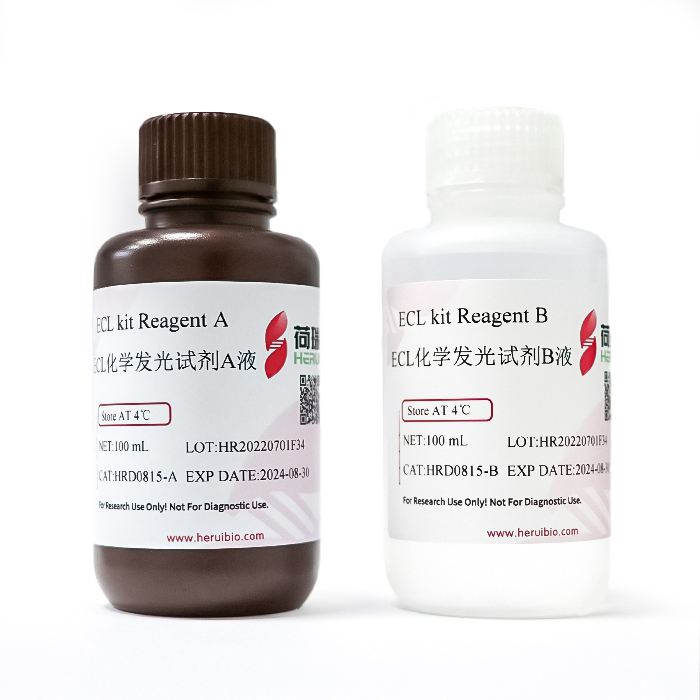
Super ECL Detection Kit Super ECL chemiluminescence Detection kit
Price:
¥395
Cargo Number:
HRD0815
Specification:
200ml 1000ml
Specification and quality control:
Product Details
Product Specification
Product Information
Product Name | Product Number | Specification | Price (Yuan) |
| Super ECL Detection Kit ECL chemiluminescence supersensitive colorimetric kit | HRD0814 | 50mL | 268 |
| Super ECL Detection Kit ECL chemiluminescence supersensitive colorimetric kit | HRD0815 | 200mL | 350 |
| Super ECL Detection Kit ECL chemiluminescence supersensitive colorimetric kit | HRD0816 | 1000mL | 1200 |
Product Description
This ECL detection reagent is a luminol-based chemiluminescent kit for detecting horseradish peroxidase (HRP)-labeled antibodies and their associated antigens.
The core principle of ECL reagent detection is luminescence by oxidation reaction: luminol, as the main component of the luminescent substrate, is oxidized by H2O2 under alkaline conditions through horseradish peroxidase (HRP) to generate an excited state intermediate of 3-aminophthalic acid, which emits photons when it returns to the ground state, with a maximum emission wavelength of 425 nm. The photon signal can be captured by X-ray film or CCD imager.
Super ECL Detection Reagent The ECL Chemiluminescent Ultrasensitive Colorimetric Kit oxidizes luminol in the presence of HRP and peroxide, allowing detection in the femtogram range of antigens. The reaction produces a prolonged chemiluminescence that can be seen on X-ray film or digital imaging systems. The ultra-high sensitivity ECL kit produces a strong, long-lived signal, which, combined with very low background levels, allows extended exposure times for detection of low-abundance proteins.
Product Features
| items | describe |
| Application & Features | Excellent sensitivity - antigen detection from picograms to low femtograms Higher signal-to-noise ratio - precise luminescent substrate, lower background More efficient Antibody saving - optimized substrate system, higher antibody binding Excellent cost performance - higher performance, lower price Excellent stability - new oxidant, stable storage for 1 year at room temperature |
| use | For research use only, not for use in humans. |
| Molecular weight | N/A |
| Mode of transport | Blue ice transportation |
| store | Store at 4°C protected from light. Stable for 1 year. |
How to use
1. Rinse the protein blot after incubation with HRP-labeled antibodies.
2. Mix ECL-A solution and ECL-B solution in equal volumes to obtain ECL working solution (prepare and use immediately). About 3-5 ml ECL working solution is required for each 5cm x 8cm blot.
Note: The pipette tips for absorbing A solution and B solution must be separated.
3. Blot the liquid on the surface of the blot membrane on absorbent paper and spread it flat on the plastic film.
4. Evenly drop the prepared ECL working solution on the surface of the blot membrane. After reacting for about 2 minutes, remove the ECL working solution.
5. Sandwich the blot membrane between two layers of plastic film and perform X-ray pressing or place it in a luminescence imager to take a picture.
Precautions
1. Do not expose the ultrasensitive ECL chemiluminescent working solution to sunlight or strong light, otherwise it will be inactivated. It is recommended to store the working solution in a brown bottle and avoid long-term exposure to sunlight. Laboratory light has little effect on the working solution.
2. When using the biotin/avidin system, avoid using skim milk powder as a blocking solution, because skim milk powder contains a variety of endogenous biotin, which is easy to produce non-specific signals.
3. Use sufficient washing buffer, blocking solution, antibody diluent and substrate working solution to cover the blot membrane to ensure that the blot membrane is in a wet state. Using a large amount of blocking solution and washing solution can reduce the generation of non-specific signals.
4. Sodium azide is an inhibitor of HRP enzyme and will interfere with the reaction system. Therefore, sodium azide should be avoided as a preservative in the buffer.
5. The fluorescence emitted within 5-30 minutes after the blot membrane is incubated with the ECL chemiluminescent working solution is the strongest, and then the fluorescence will weaken over time. When the fluorescence of the protein spot is weak, the exposure time can be appropriately extended.
6. For your safety and health, please wear a lab coat and disposable gloves when operating.
7. This product is for scientific research purposes only!