Popular
Searches:
Popular
Searches:
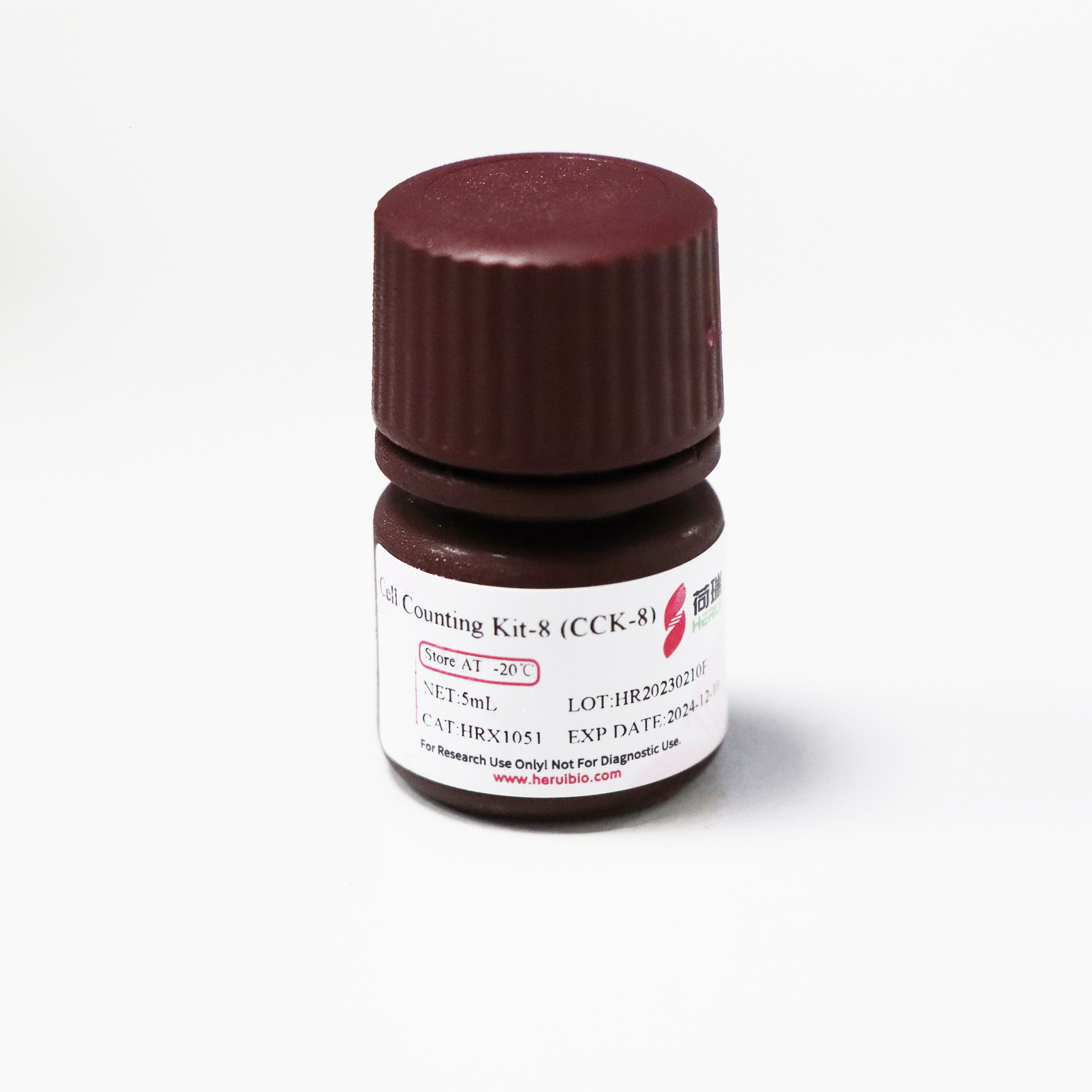
Cell Counting Kit-8 (CCK-8)
Price:
¥138
Cargo Number:
HRX1051
Specification:
100T 500T 1000T 3×1000T 10×1000T
Specification and quality control:
Product Details
Product Specification
Product Information
Product Name | Product Number | Specification | Price (Yuan) |
| Cell Counting Kit-8 (CCK-8) | HRX1051 | 1×5mL(500T) | 240 |
| Cell Counting Kit-8 (CCK-8) | HRX1052 | 2×5mL(1000T) | 400 |
| Cell Counting Kit-8 (CCK-8) | HRX1053 | 6×5mL(3000T) | 1128 |
| Cell Counting Kit-8 (CCK-8) | HRX1054 | 10×5mL(5000T) | 1760 |
| Cell Counting Kit-8 (CCK-8) | HRX1055 | 20×5mL(10000T) | 2880 |
Detection principle
Cell Counting Kit - 8 , referred to as CCK-8 kit, is a rapid and highly sensitive detection kit based on WST-8 (chemical name: 2-(2-methoxy-4-nitrophenyl)-3-(4-nitrophenyl)-5-(2,4-disulfonylbenzene)-2H-tetrazolyl monosodium salt) and is widely used in cell proliferation and cytotoxicity.
WST-8 is an upgraded product of MTT. Its working principle is: in the presence of electron coupling reagent, it can be reduced by dehydrogenase in mitochondria to generate highly water-soluble orange-yellow Formazan product . The depth of color is proportional to cell proliferation and inversely proportional to cytotoxicity. The OD value is measured at a wavelength of 450nm using an enzyme marker, which indirectly reflects the number of living cells.
The CCK-8 method is widely used, such as drug screening, cell proliferation assay, cytotoxicity assay, tumor drug sensitivity test and activity detection of biological factors.
application
1) Cell Proliferation Assay - CCK-8 is water-soluble, stable in culture, and non-toxic.
2) Cell Viability Assay - Metabolic activity and dye production change in proportion to altered viability.
3) Cytokine Assay - Measures cytokine-induced proliferation. Cells can be recovered and expanded at the end of the study if desired.
4) Cytotoxicity Assays - Cell death from cytotoxic chemicals has no effect on color development, only living cells convert the reagent into a colorimetric indicator. The reagents themselves have negligible toxicity and are generally safe for cells.
How to use
Cell number determination
1. Inoculate the cell suspension (100 μL/well) in a 96-well plate. Pre-incubate the plate in a humidified incubator (e.g., at 37°C, 5% CO2 ) .
2. Add 10 μL of CCK-8 solution to each well of the plate. Be careful not to introduce air bubbles into the wells as they will interfere with the OD readings.
3. Incubate the plate in the incubator for 1-4 hours.
4. Measure the absorbance at 450 nm using a microplate reader.
Cell proliferation and cytotoxicity assays
1. Seed cells at a density of 10 3 -10 4 cells/well in 96-well plates in 100 μL of culture medium with or without the test compound. Incubate the cells at 37°C in a CO 2 incubator for 24 hours.
2. Add 10 μL of the test substance at different concentrations to the plate.
3. Incubate the plate in the incubator for the appropriate time (e.g., 6, 12, 24, or 48 hours).
4. Use a repeating pipette to add 10 μL of CCK-8 solution to each well of the plate. Be careful not to introduce bubbles into the wells as they will interfere with the OD readings.
5. Incubate the plate in the incubator for 1-4 hours.
6. Before reading the plate, it is important to mix gently on an orbital shaker for 1 minute to ensure an even distribution of color.
7. Measure the absorbance at 450 nm using a microplate reader.
Data analysis
There are several methods for statistical analysis, you can choose to use OD values or cell number, we provide one of the methods.
Cell survival rate (%) = [(As-Ab)/(Ac-Ab)] × 100
Inhibition rate (%) = [(Ac-As)/(Ac-Ab)] × 100
As = absorbance of experimental wells (absorbance of wells containing cells, culture medium, CCK-8 and test compound).
Ab = absorbance of blank wells (absorbance of wells containing culture medium and CCK-8).
Ac = absorbance of control wells (absorbance of wells containing cells, medium and CCK-8).
Make a standard curve
1. Count the number of cells in the cell suspension using a cell counting plate.
2. Use culture medium to dilute the cell suspension in equal proportions to a concentration gradient, usually 5-7 concentration gradients are required, with several replicates in each group. Then inoculate the cells. (Note the number of cells in each well. If you dilute the cell suspension in a tube, be careful to mix the cells again before adding it to the wells of the culture plate. The volume of cell suspension in each well should be consistent.)
3. Culture until cells adhere (usually 2-4 hours), then add 10 μL CCK-8 per 100 μL culture medium. Continue incubation for 1-4 hours, and measure the absorbance at 450nm with a microplate reader. Make a standard curve with the number of cells as the X-axis coordinate and the OD value as the Y-axis coordinate. The number of cells in the sample to be tested can be determined based on this curve. The prerequisite for using this standard curve is that the culture and detection conditions are the same.
Storage conditions
Store at 4 ℃ away from light, valid for one year (recommended). Store at -20 ℃ in a dry place away from light, valid for two years.
CCK-8 Method and Advantages
1) Table 1 Comparison of the advantages of CCK-8 assay and other cell proliferation/toxicity detection methods
Detection Methods | MTT assay | XTT method | WST-1 method | CCK-8 method |
Water solubility of formazan products | Poor (need to add organic solvent to dissolve before testing) | good | good | good |
Product Characteristics | powder | 2 bottles of solution | Solution | 1 bottle of solution |
How to use | Use after preparing solution | Ready-to-use | Ready to use | Ready to use |
Detection sensitivity | high | Very high | Very high | high |
Detection time | Longer | Shorter | Shorter | Shortest |
Detection wavelength | 560-600 nm | 420-480 nm | 420-480 nm | 430-490 nm |
Cytotoxicity | High, cell morphology completely disappeared | Very low, cell morphology unchanged | Very low, cell morphology unchanged | Very low, cell morphology unchanged |
Reagent stability | generally | Poor | generally | very good |
Batch sample testing | Can | Very suitable for | Very suitable for | Very suitable for |
Convenience | generally | Convenient | Convenient | Very convenient |
2) Phenol red and serum will not interfere with the detection of CCK-8 method;
3) The cytotoxicity is very low, so after adding WST-8 for color development, the microplate reader can be used to read the sample repeatedly at different times to find the optimal measurement time.
Precautions
1) Ensure that the drug and CCK-8 are evenly distributed in the culture medium.
2) The more the cells proliferate, the darker the color; the stronger the cell toxicity, the lighter the color.
3) For adherent cells, at least 1000 cells per well (100 μL medium) are required. For leukocytes, at least 2500 cells per well (100 μL medium) are required due to lower sensitivity. The recommended maximum number of cells per well of a 96-well plate is 25,000. If using a 24-well or 6-well plate for this assay, please calculate the corresponding number of cells per well and adjust the volume of CCK-8 to 10% of the total liquid volume per well.
4) Because the CCK-8 assay is based on dehydrogenase activity in living cells, conditions or chemicals that affect dehydrogenase activity may result in differences between the actual number of viable cells and the number of viable cells measured using CCK-8.
5) WST-8 may react with reducing agents to form WST-8 formazan. If reducing agents (such as some antioxidants) are used, it will interfere with the test. If there are too many reducing agents in the system to be tested, it is necessary to remove them.
6) After 2 hours of incubation, the background OD value is generally 0.1-0.2 units.
7) Be careful not to introduce air bubbles into the wells as they will interfere with the OD values.
8) If you want to sterilize the CCK-8 solution, filter the solution using a 0.2 μm membrane.
9) Incubation times vary depending on the type and number of cells in the well. In general, leukocytes stain more weakly, so longer incubation times (up to 4 hours) or larger numbers of cells (~10 5 cells/well) may be required.
10) If high turbidity is present in the cell suspension, measure and subtract the OD value of the sample at 600nm or higher.
11) CCK-8 cannot be used for cell staining.
12) Phenol red in the culture medium will not affect the experimental results. The absorbance of phenol red can be eliminated by subtracting the background absorbance in the blank well during calculation, so it will not affect the detection.
13) CCK-8 has very low toxicity, and after the CCK-8 assay is completed, the same cells can be used for other cell proliferation assays, such as crystal violet assay, neutral red assay, or DNA fluorescence assay. (Unless the cells are extremely rare, this is not recommended.)
14) This kit can be used for E. coli but not for yeast cells.
15) Before reading the plate, you can gently mix on a shaker.
16) We recommend seeding cells in wells near the center of the culture plate. The culture medium in the outermost circle of wells is prone to evaporation, so these wells can be filled with PBS, water, or culture medium.
17) If you do not have a 450 nm filter, you can also use a filter with absorbance between 430 and 490 nm. The 450 nm filter has the best sensitivity.
18) Measure the absorbance at 450 nm. If you need to perform dual-wavelength measurement, you can measure the absorbance at 650 nm as a reference wavelength.
19) The presence of metal ions in drugs may affect the sensitivity of CCK-8. Lead chloride, ferric chloride, and copper sulfate at a final concentration of 1 mM will inhibit the color development reaction by 5%, 15%, and 90%, reducing the sensitivity. If the final concentration is 10 mM, it will be 100% inhibited.
20) This product is for scientific research purposes only!