Popular
Searches:
Popular
Searches:
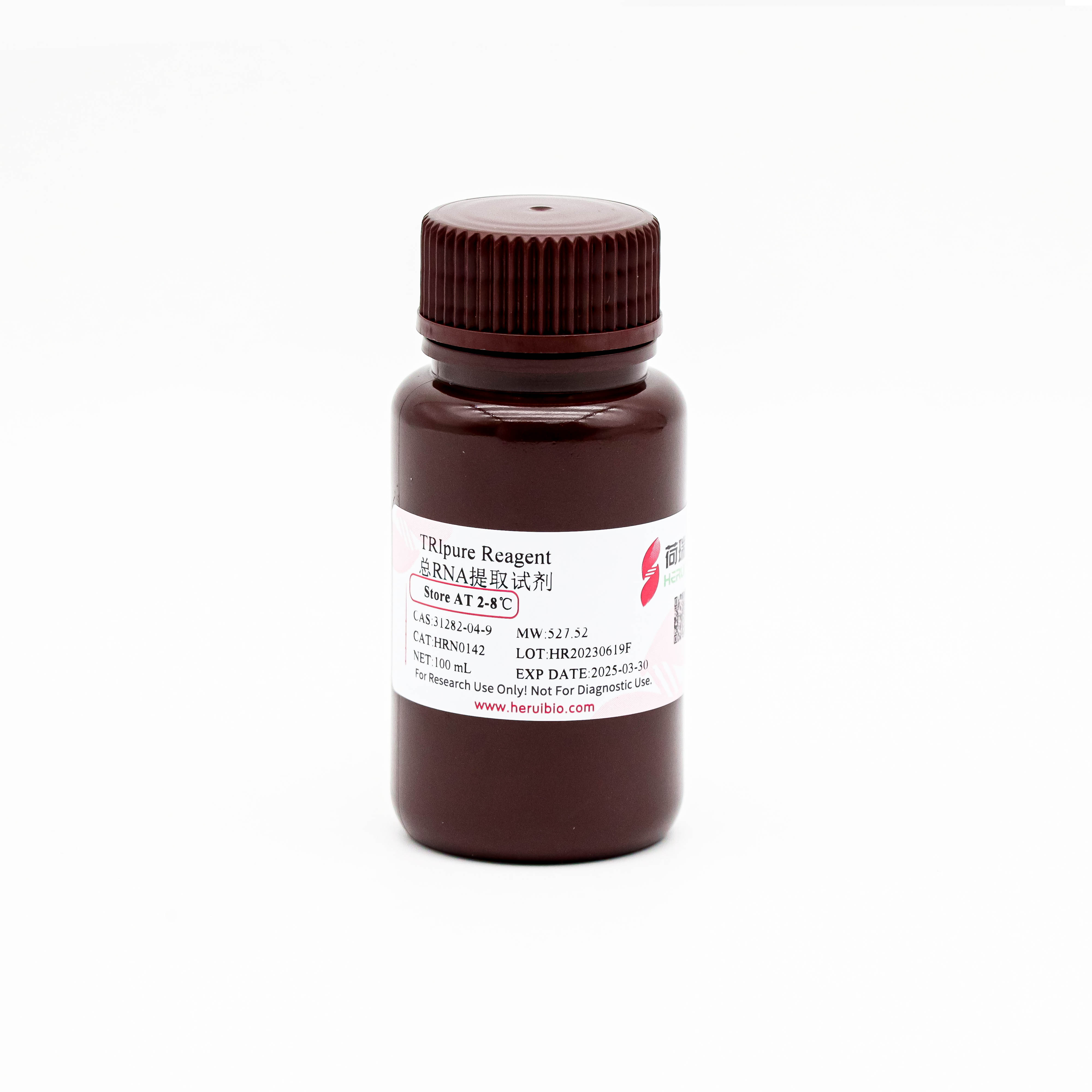
TRIpure Reagent
Price:
¥150
Cargo Number:
HRN0141
Specification:
50mL 100mL
Specification and quality control:
Product Details
Product Specification
Product Information
Product Name | Product Number | Specification |
TRIpure Reagent Total RNA Extraction Reagent | HRN0142 | 100mL |
Product Description
TRIPure Reagent is a reagent for extracting total RNA directly from cells or tissues. It maintains the integrity of RNA while disrupting and lysing cells. After adding chloroform and centrifuging, the sample is separated into an aqueous layer and an organic layer (bright red lower layer). RNA is present in the aqueous layer. After collecting the upper aqueous layer, RNA can be reduced by isopropanol precipitation. After removing the aqueous layer, DNA and protein in the sample can also be reduced by precipitation in sequence. Ethanol precipitation can precipitate DNA in the middle layer, and adding isopropanol to the organic layer can precipitate protein. Co-purification of DNA is particularly effective for standardizing RNA yields between samples.
Whether it is human, animal, plant or bacterial tissue, this method has a good separation effect on small amounts of tissue (50-100mg) and cells (5×10 6 ) as well as large amounts of tissue (≥1g) and cells (>10 7 ). The simplicity of TRIpure reagent operation allows multiple samples to be processed simultaneously. All operations can be completed within one hour. Total RNA extracted by TRIpure can avoid DNA and protein contamination. Therefore, it can be used for Northern blot analysis, dot hybridization, poly(A)+ selection, mRNA purification, in vitro translation, RNAse protection analysis and molecular cloning. If used for PCR, when the two primers are located in a single exon, it is recommended to use amplification-grade DNase I to treat the extracted total RNA.
TRIpure reagent facilitates the extraction of a variety of RNAs of different species and molecular weights. For example, RNA extracted from rat liver was electrophoresed on an agarose gel and stained with ethidium bromide, showing many discontinuous high molecular weight bands between 7 kb and 15 kb (mRNA and hnRNA components), two dominant ribosomes ~5 kb (28S) and ~2 kb (18S), and low molecular weight RNAs between 0.1 and 0.3 kb (tRNA, 5S). When the extracted RNA was diluted in TE, its A260/A280 ratio was ≥1.8.
Product composition
Kit composition | save | 100 mL | Remark |
TRIpure | 4℃, protected from light | 100 mL | |
Chloroform | Room temperature | 20 mL | Bring Your Own |
Isopropyl alcohol | Room temperature | 50 mL | Bring Your Own |
75% ethanol | Room temperature | 100 mL | Bring Your Own |
RNase-free H 2 O | Room temperature | 20 mL | Bring Your Own |
This kit can be stored at room temperature for 12 months without affecting its effectiveness.
Application
Suitable for rapid extraction of total RNA, DNA and protein from various animal and plant tissues/cells
How to use
1. Cell lysis or tissue homogenization:
1) Adherent cells: Aspirate the culture medium and add 1 mL TRIpure Reagent to every 10 cm2 (6-well plate or 35 mm dish) of cells to cover the cultured cells. Use a pipette or pipette to blow 2-3 times. The cells should be completely lysed and then transferred to a centrifuge tube.
2) Suspended cells: Collect the cells by centrifugation and aspirate the liquid. Add 1 mL TRIpure Reagent to every 5 million to 10 million (5×10 6 -1×10 7 ) animal, plant or yeast cells, or 10 million (1×10 7 ) bacteria. Use a pipette or pipette to blow to completely lyse. If some yeast and bacteria are not fully lysed, use a homogenizer to homogenize to ensure complete lysis. Transfer to a centrifuge tube.
3) Tissue: Cut the tissue into small pieces and put them into a glass homogenizer. Frozen tissue can be ground and homogenized in a mortar. Add 1 mL TRIpure Reagent to every 50-100 mg of tissue and homogenize until completely lysed. Transfer to a centrifuge tube.
The lysate should be a clear, transparent, viscous liquid. Leave at room temperature for 5 minutes. For tissue samples rich in impurities such as polysaccharides and proteins, insoluble substances may remain after homogenization. Centrifuge at 12,000 × g at 4°C for 10 minutes, and then pipette the supernatant into a new centrifuge tube.
2. Separation: Add 0.2 times the volume of chloroform (0.2 mL chloroform for 1 mL TRIpure Reagent) to the centrifuge tube containing the lysate, shake thoroughly on a shaker for 30 seconds, and leave at room temperature for 2-3 minutes. Centrifuge at 12000×g for 10 minutes at 4℃, then pipette the upper aqueous phase containing total RNA into a new centrifuge tube. About 0.5-0.6 mL can be pipetted per mL of TRIpure Reagent. The organic phase and the middle layer contain DNA and protein and should be avoided.
3. Precipitation: Add 0.5 mL of isopropanol per mL of TRIpure Reagent, invert several times to mix, and let the tube precipitate for 10 minutes at room temperature. Centrifuge at 12,000 × g at 4°C for 10 minutes. RNA precipitate can be seen at the bottom of the tube. Discard the supernatant, add 1 mL of 75% ethanol per mL of TRIpure Reagent, and gently invert to mix to wash the RNA precipitate. Centrifuge at 12,000 × g at 4°C for 2 minutes, discard the liquid, and be careful not to discard the RNA precipitate. Invert and dry at room temperature for 5 to 10 minutes.
4. Dissolution: Add appropriate amount of DEPC-treated water to dissolve the RNA precipitate. Store at -80℃.
Reference dosage
Table 1. Maximum sample volume that can be adequately lysed per mL of TRIPure Reagent
Sample Type | Sample usage |
Adherent cells | 10 cm2 culture area |
Suspended animal, plant or yeast cells | 5×10 6 -1× 10 7 |
bacteria | 107 |
Animal tissue | 50-100 mg |
Plant tissues (not high in polysaccharides and polyphenols) | 50-100 mg |
【Note】: Excessive sample volume may result in insufficient lysis and reduce product purity.
Operation process
1. Homogenization
(1) Organization
Use glass or powerful homogenizer to homogenize tissue samples, adding 1 mL of TRIpure for every 50-100 mg of tissue. The volume of tissue sample during homogenization should not exceed 10% of the volume of TRIpure.
(2) Cells grown in monolayers
Directly add 1 mL of TRIpure to a 3.5 cm diameter culture plate to dissolve the cells, cover and repeatedly pipette to dissolve the cells, and remove the cell lysate in batches using a pipette. Determine the amount of TRIpure required based on the area of the culture plate rather than the number of cells (add 1 mL per 10 cm2 ) . Insufficient TRIpure may result in DNA contamination in the extracted RNA.
(3) Cells growing in suspension
Pellet the cells by centrifugation and lyse them by pipetting repeatedly in TRIpure reagent. Add 1 mL of TRIpure for every 5-10 × 10 6 animal cells, plant or yeast cells or every 1 × 10 7 bacteria. Avoid washing the cells before adding TRIpure because this increases the likelihood of mRNA degradation. A homogenizer may be required to disrupt some yeast and bacteria. Optional: An additional separation step may be required when the sample is rich in protein, fat, polysaccharides or extracellular material such as muscle, adipose tissue and plant tubers. After homogenization, centrifuge at 12,000 × g for 10 minutes at 2-8°C to remove insoluble material from the homogenate. The remaining pellet contains cell membranes, polysaccharides, and high molecular weight DNA, while the supernatant contains RNA. In samples from adipose tissue, a large amount of fat floats in the top layer and should be removed. In each case, the clear homogenate was transferred to a clean tube, chloroform was added and the separation was continued as described below.
2. Separation stage
Incubate the homogenate sample at 15-30°C for 5 minutes to completely disintegrate the ribosomes. Add 0.2 mL of chloroform per 1 mL of TRIpure. Cap the sample tube tightly, shake the tube vigorously by hand for 15 seconds and incubate it at room temperature for 2-3 minutes. Centrifuge at 2-8°C at a high speed and a centrifugal force not exceeding 12,000 × g for 15 minutes. After centrifugation, the mixture separates into three layers: a lower phenol-chloroform layer, a middle layer, and an upper colorless aqueous layer. RNA is exclusively present in the aqueous layer. The volume of the aqueous layer is approximately 60% of the volume of the added TRIpure.
3. RNA Precipitation
Transfer the aqueous layer to a clean tube and retain the organic layer if you wish to separate DNA and protein. Precipitate RNA by mixing the aqueous layer with isopropanol. Use 0.5 mL of isopropanol for every 1 mL of TRIpure initially homogenized. Incubate the mixed sample at 15-30°C for 10 minutes and centrifuge at 2-8°C at a high speed refrigerated centrifuge of no more than 12,000 × g for 10 minutes. The RNA precipitate is usually not visible before centrifugation and forms a gelatinous pellet adhering to the sides and bottom of the tube.
4. Washing RNA
Remove the supernatant. Wash the RNA pellet once with 75% ethanol, adding at least 1 mL of 75% ethanol per 1 mL of TRIpure. Vortex the sample and centrifuge at 2-8°C at a high speed and no more than 7,500 × g for 5 minutes.
5. Redissolution of RNA
At the end of the procedure, briefly dry the RNA pellet (air dry or vacuum dry for 5-10 minutes). Do not centrifuge the RNA in a vacuum tube. It is especially important not to allow the RNA pellet to completely dry as this greatly reduces its solubility. Partially dissolved RNA samples have an A260/280 ratio of <1.6. Dissolve the RNA by pipetting several times with RNase-free water or 0.5% SDS solution using a pipette tip (avoid using SDS when the RNA will be used for enzymatic digestion reactions later). RNA can also be redissolved in 100% formamide (deionized) and stored at -70°C.
6. Product testing
A. RNA integrity testing
1) Take 1 µL RNA and add appropriate RNA loading buffer and mix well.
2) Perform electrophoresis test. If three clear bands appear, it proves that the RNA integrity is good.
B. RNA purity test
Measure the OD values at 260 nm and 280 nm and calculate the A260/A280 ratio. The ratio of pure RNA should be around 2.0.
Transportation and storage methods
Transport with ice packs. Store at 2-8℃, away from light, valid for 1 year.
Precautions
1. This product contains phenol, which is toxic and corrosive. If the toxic substance comes into contact with the skin or is swallowed accidentally, it will cause burns. Once it comes into contact with the skin, wash it immediately with plenty of detergent and water. If you feel unwell, see a doctor and seek the correct treatment plan for phenol and other ingredients.
2. Please wear lab coat and disposable gloves. When the amount of TRIpure is less than 2mL, it is recommended to use clean disposable polypropylene test tubes to avoid RNase contamination.
3. When using a large amount of TRIpure, glass tubes (Corex) or polypropylene tubes can be used. Check in advance to ensure that the tubes can withstand the centrifugal force of 12,000×g after adding TRIpure and chloroform. Do not use cracked or damaged tubes.
4. You need to prepare chloroform, isopropanol (newly opened or for RNA extraction), 75% ethanol (prepared with DEPC-treated water), DEPC and DEPC-treated water.
5. After homogenization with TRIPure Reagent and before adding chloroform, samples can be stored at –60~–70°C for at least one month. RNA precipitates (step 4, RNA rinses) can be stored in 75% ethanol at 2~8°C for at least one week and at –5~–20°C for at least one year.
6. RNA precipitated in 75% ethanol can be stored at 4°C for 1 week and at -20°C for 1 year.
7. To isolate RNA from a small amount of tissue (1-10 mg) or cells (102-104): Add 800 µL TRIpure to the tissue or cells. After the sample is lysed, add chloroform and perform the extraction procedure in step 2. Before precipitating the RNA with isopropanol, add 5-10 µg of RNase-free glycogen as a carrier for the aqueous layer. To reduce its viscosity, aspirate twice with a 26-gauge syringe before adding chloroform to cut off the genomic DNA. Glycogen will remain in the aqueous layer and co-precipitate with the RNA. It will not inhibit the synthesis of the first strand of the reverse transcription reaction or PCR until it is concentrated to 4 mg/mL.
8. RNA has a relatively short half-life and is easily degraded. It is recommended to conduct subsequent experiments as soon as possible after extraction.
9. This product is for scientific research purposes only!