Popular
Searches:
Popular
Searches:
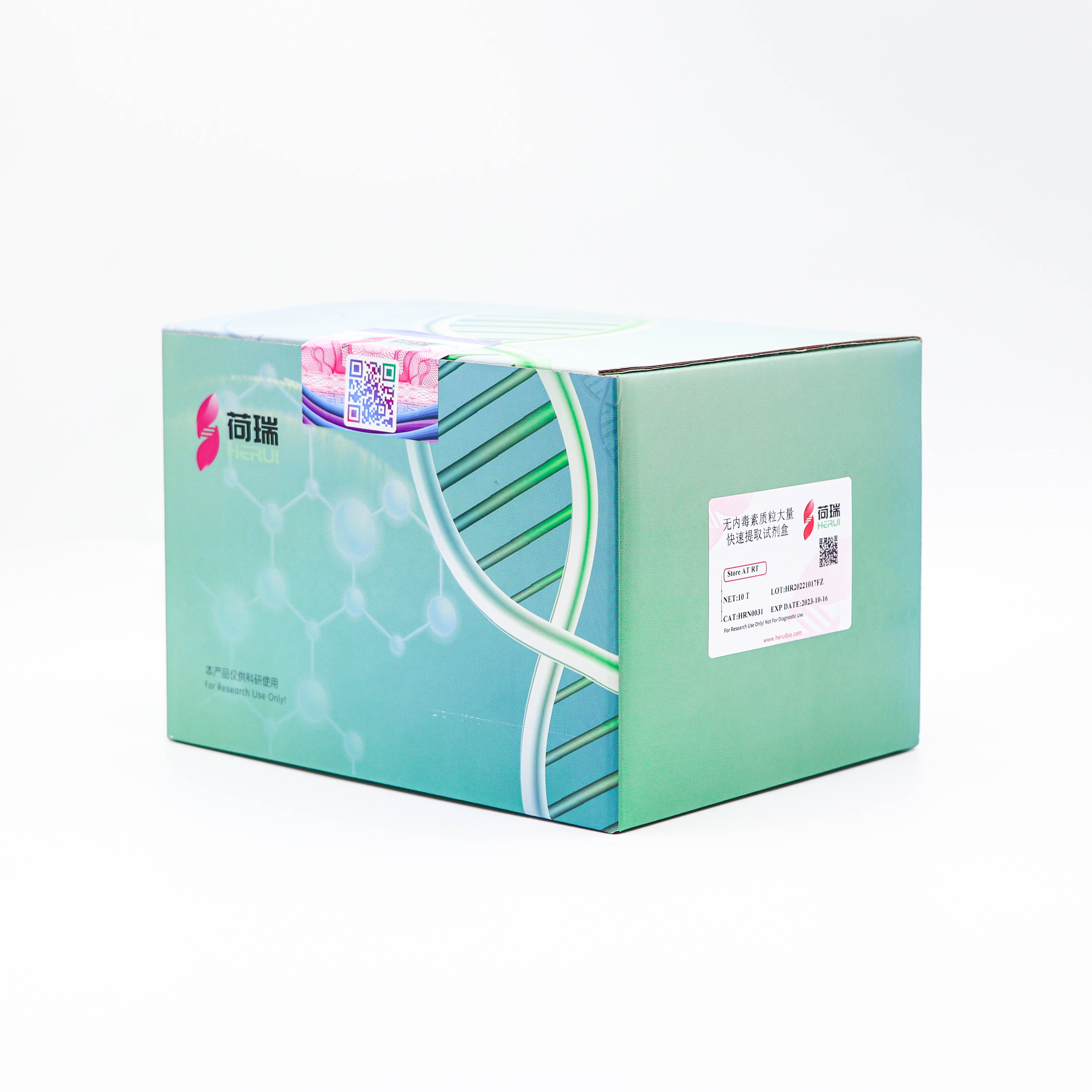
EndoFree Plasmid Maxi Kit
Price:
¥950
Cargo Number:
HRN0031
Specification:
10T
Specification and quality control:
Product Details
Product Specification
Product Information
Product Name | Product Number | Specification |
EndoFree Plasmid Maxi Kit EndoFree Plasmid Maxi Kit | HRN0031 | 10 times |
Product Description
This kit uses an improved SDS-alkaline lysis method to lyse cells. The crude extract is treated with an efficient endotoxin removal system to remove endotoxins. The silica matrix membrane in the centrifugal adsorption column selectively binds to the plasmid DNA in the solution under high salt and low pH conditions. The impurities and other bacterial components are then removed by rinsing solution. Finally, the pure plasmid DNA is eluted from the silica matrix membrane using a low salt and high pH elution buffer.
Each time, 100-200 ml of bacterial culture fluid can be processed, and theoretically up to 2 mg of plasmid DNA can be extracted
Product composition
Kit composition | save | 10 times |
RNase A (10 mg/mL) | 4℃ | 1mL |
Buffer I | 4℃ | 120mL |
Buffer II | Room temperature | 120mL |
Buffer III | Room temperature | 120 mL |
Buffer PI | Room temperature | 100mL |
Buffer ER | Room temperature | 30mL |
Buffer PB | Room temperature | 120mL |
Buffer PW | Room temperature | 72mL Please add 168mL of anhydrous ethanol before first use |
Buffer PE | Room temperature | 50mL |
Buffer TE | Room temperature | 30mL |
Syringe Endotoxin Filter | Room temperature | 10 |
Adsorption column and centrifuge tube (50mL) | Room temperature | 10 |
Features
1. The silicon matrix membrane in the centrifugal adsorption column is all made of high-quality special adsorption membrane. The difference in adsorption amount between columns is very small and the repeatability is good.
2. No toxic reagents such as phenol and chloroform are required, and no ethanol precipitation is required. It is fast and convenient. 0.5-2 mg of pure high-copy plasmid DNA can be quickly extracted from 100-200 mL of Escherichia coli LB (Luria-Bertani) culture medium, and the extraction rate is 80-90%.
3. The plasmid DNA extracted by this kit has extremely low endotoxin content (<0.1 EU/μg DNA) and excellent cell transfection effect. It can also be directly used for enzyme digestion, transformation, PCR, in vitro transcription, sequencing, and other molecular biology experiments.
Transportation and storage methods
1) The kit can be stored at room temperature for 12 months without affecting its effectiveness.
2) When using for the first time, add all the RNase A in the kit to Buffer I (final concentration 100ug/mL) and store at 4°C. If RNase A in Buffer I is inactivated, the extracted plasmid may be mixed with trace amounts of residual RNA. In this case, add RNase A to Buffer I.
3) When the ambient temperature is low, SDS in Buffer II may precipitate and appear turbid or precipitate. It can be heated in a 37°C water bath for a few minutes to restore clarity. Do not shake violently to avoid excessive foaming.
4) Avoid long-term exposure of reagents to air to prevent volatilization, oxidation, and pH changes. The lid of each solution should be tightly closed after use .
Precautions
1. All centrifugation steps were performed at room temperature, unless otherwise specified , using a benchtop centrifuge capable of reaching 12,000 x g with a 50 mL rotor.
2. The amount of plasmid extracted is related to factors such as bacterial culture concentration and plasmid copy number. If the extracted plasmid is a low-copy plasmid or a large plasmid larger than 10kb, the amount of bacteria used should be increased, and the amount of Buffer I, Buffer II, and Buffer III should be increased proportionally. The elution buffer should be preheated at 70°C. The adsorption and elution time can be appropriately extended to increase the extraction efficiency.
3. The concentration and purity of the obtained plasmid DNA can be detected by agarose gel electrophoresis and UV spectrophotometer. An OD260 value of 1 is equivalent to about 50μg/mL DNA. The electrophoresis may be a single band or two or more DNA bands. This is mainly caused by the different positions of supercoiled plasmids of different degrees, which is related to the length of time the extract is cultivated and the intensity of the operation during extraction. Under normal operation, the basic supercoil of our products can exceed 90% .
4. The exact molecular size of plasmid DNA can only be known after linearization by enzyme digestion and comparison with DNA molecular weight marker. Plasmids in a circular or supercoiled state have uncertain migrating positions and their exact size cannot be known by electrophoresis.
5. The elution buffer EB does not contain the chelating agent EDTA , which does not affect downstream enzyme digestion, ligation and other reactions. Water elution can also be used , but the pH should be greater than 7.5 . Too low pH will affect the elution efficiency. When eluting with water, the plasmid should be stored at -20°C. If plasmid DNA needs to be stored for a long time, it can be eluted with TE buffer (10mM Tris-HCl, 1mM EDTA, pH 8.0), but EDTA may affect downstream enzyme digestion reactions, so it can be appropriately diluted when used.
How to use
hint:
→ Before using for the first time, please add 84 mL of anhydrous ethanol to Buffer PW and mix thoroughly. After adding, please check the box to mark that ethanol has been added to avoid adding it multiple times!
→ Add RNase A to Buffer I, mix well, and store at 2-8℃ after each use.
1. Take 100 ml-150 ml (200 ml-250 ml for low copy) of overnight cultured bacterial solution and add it to a centrifuge tube. Centrifuge at 8,000 rpm for 3 min to collect the bacteria and discard the supernatant.
2. Add 10 ml of Buffer I (please check whether RNase A has been added first) and use a pipette or vortex oscillator to thoroughly suspend the precipitate.
3. Add 10 ml of Buffer II and immediately invert the tube gently 6-8 times (do not shake violently) to fully lyse the bacteria. Leave at room temperature for 5 min.
4. Add 10 ml of Buffer III to the centrifuge tube, gently invert it upside down 6-8 times (invert it upside down immediately after adding the solution to avoid local precipitation), and mix thoroughly until the solution has white, dispersed flocculent precipitation. After leaving it at room temperature for 10 minutes, centrifuge it at 8,000 rpm for 10 minutes.
5. Transfer all the supernatant solution from step 4 to the endotoxin adsorption filter column (please avoid pouring a large amount of precipitate to avoid clogging the filter), slowly push the push handle to filter, and collect the filtrate in a clean 50 mL tube.
6. Add 0.3 times the volume of Buffer PI and 0.1 times the volume of Buffer ER to the filtrate, mix by inversion, and transfer to the adsorption column (the adsorption column is placed in a 50 ml collection tube).
Note: The maximum volume of the adsorption column is 20 ml, so it is necessary to pass the column several times. In some cases, the centrifuge rotor has a large inclination angle. In this case, it is recommended that the volume of solution added to the adsorption column does not exceed 15 ml to prevent leakage.
7. Centrifuge at 8,000 rpm for 2 min, discard the waste liquid in the collection tube, and put the adsorption column back into the collection tube.
8. Add 10 mL of deproteinized buffer PB to the adsorption column and centrifuge at 8,000 rpm for 2 min.
9. Add 10 ml of Buffer PW to the adsorption column, centrifuge at 8,000 rpm for 2 min, discard the waste liquid, and put the adsorption column back into the collection tube.
10. Repeat step 9.
11. Add 3 ml of Buffer PE to the adsorption column, centrifuge at 8,000 rpm for 2 min at room temperature, and discard the waste liquid.
12. Place the adsorption column back into the collection tube and centrifuge at 8,000 rpm for 5 min to remove the remaining rinse solution.
13. Open the cover of the adsorption column and leave it at room temperature for a few minutes to completely dry the residual rinse solution in the adsorption material.
14. Place the adsorption column in a clean 50 ml collection tube, add 1-2 ml of Buffer TE to the middle of the adsorption membrane, place at room temperature for 2 min, and then centrifuge at 8,000 rpm for 2 min. Transfer all the plasmid DNA from the centrifugation into a clean 1.5 ml centrifuge tube and store at -20℃.