Popular
Searches:
Popular
Searches:
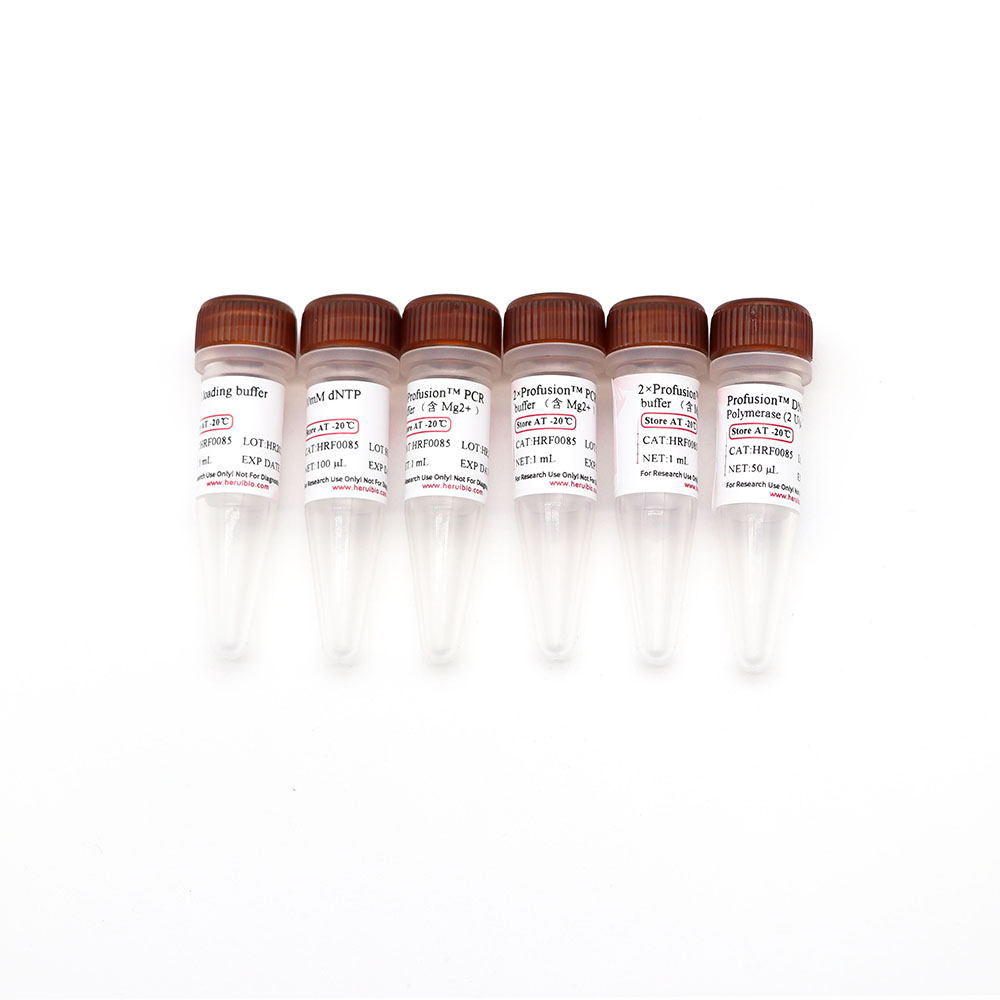
Profusion™ DNA Polymerase
Price:
¥288
Cargo Number:
HRF0085
Specification:
100U 500U 1000U
Specification and quality control:
Product Details
Product Specification
Product Information
Product Name | Product Number | Specification |
Profusion™ DNA Polymerase Ultra-high-fidelity DNA polymerase | HRF0085 | 100 U |
HRF0086 | 500 U | |
HRF0087 | 1000 U |
Product Description
Profusion™ DNA Polymerase is an ultra-high-fidelity DNA polymerase that uses protein fusion technology and has universal primer annealing capabilities. It is a Pyrococcus-like proofreading DNA polymerase fused to a processivity-enhancing domain, which enables Profusion™ DNA polymerase to produce PCR sequences with high accuracy, sensitivity, and inhibitor tolerance. The enzyme has 5'→3'DNA polymerase activity and 3'→5'exonuclease activity, and its fidelity is 100 times that of Taq DNA polymerase. The addition of extension factors to the enzyme solution enables the enzyme to amplify long fragments, with an amplification speed of 15-30sec/kb, and the length of the amplified target fragment can be up to 20 kb. This product is equipped with an optimized buffer and an added PCR enhancement component, making the enzyme suitable for the amplification of complex templates. The amplified product has a blunt end.
Product composition
Component name | Specification | ||
HRF0085 | HRF0086 | HRF0087 | |
(100 U) | (500 U) | (1000 U) | |
Profusion™ DNA Polymerase (2 U/μL) | 50 μL | 250 μL | 250 μL×2 |
2×Profusion™ PCR buffer (containing Mg 2+ ) | 1 mL×3 | 1 mL×15 | 1 mL×30 |
10mM dNTP | 100 μL | 500 μL | 1000 μL |
6×DNA loading buffer | 1 mL | 1 mL×5 | 1 mL×10 |
Application
1. High-fidelity PCR
2. Gene cloning
3. Generate sequencing template
4. GC-High PCR
5. Long fragment PCR (up to 20 kb)
6. Mutation
7. High-throughput PCR
Activity Definition
Using activated salmon sperm DNA as template/primer, the activity of 1 U was defined as the amount of 10 nmol of total nucleotides taken up as acid-insoluble matter at 74°C for 30 min.
Transportation and storage methods
Transported with ice packs. Store at -20℃, valid for 1 year.
Recommended PCR reaction system (prepared on ice)
Components | Volume (μL) | Final concentration |
ddH2O | to 50 μL | - |
2×Profusion™ PCR buffer (containing Mg 2+ ) | 25 μL | 1× |
10mM dNTP | 1uL | 0.2mM |
DNA template | Moderate | - |
Primer forward (10 μM) | 2.5 μL | 0.5 μM |
Primer reverse (10 μM) | 2.5 μL | 0.5 μM |
Profusion™ DNA Polymerase (2 U/μL) | 0.5 μL | 1 U/50 μL |
【Note】
1) Reagent use: Please fully dissolve and mix before use.
2) Polymerase concentration: 1 U/50 μL is recommended, and can be optimized between 0.5-2 U/50 μL, but should not exceed 2 U/50 μL.
3) Addition of polymerase: High-fidelity polymerase has 3'→5' exonuclease activity, which may degrade the primer. When preparing the reaction system, the enzyme should be added last.
4) Final concentration of Mg 2+ : The final concentration of the system is 1.5 mM. If there is a special need, 50 mM MgCl 2 can be used , and the concentration can be increased by 0.2-0.5 mM.
5) High GC template: When amplifying fragments with high GC content, adding DMSO with a final concentration of 3% to the system is beneficial to amplification and can significantly improve the efficiency of amplification.
Recommended usage of different templates (50 μL reaction system):
Template Type | Amplified fragment 1kb-10kb |
Genomic DNA | 50 ng-250 ng |
Plasmid or viral DNA | 1pg-10ng |
cDNA | 1-5 μL (no more than 10% of the total PCR reaction volume) |
PCR amplification program: There are three programs to choose from, and the two-step program is preferred.
Two-step method (preferred)
Cycle steps | temperature | time | Number of cycles |
Pre-denaturation | 98℃ | 30s | 1 |
transsexual | 98℃ | 5-10 sec | 25-35 |
extend | 72℃ | 15-30 sec/kb | |
Final extension | 72℃ | 5-10 min | 1 |
Three-step method (conventional procedure)
Cycle steps | temperature | time | Number of cycles |
Pre-denaturation | 98℃ | 30 sec | 1 |
transsexual | 98℃ | 5-10 sec | 25-35 |
annealing | 65℃ | 10-30 sec | |
extend | 72℃ | 15-30 sec/kb | |
Final extension | 72℃ | 10 min | 1 |
【Note】
1) Pre-denaturation temperature and time: Recommended temperature: 98°C, time: 30S, 3 min for complex and high GC content templates.
2) Annealing temperature and time: Recommended temperature: 72°C. A temperature gradient can also be set up to find the optimal temperature for annealing the index material as needed.
3) Extension temperature and time: Recommended temperature: 72°C. Time: 30 sec/kb. For complex templates, it can be extended to 60 sec/kb according to actual conditions.
4) Amplification product: Please store the PCR amplification product at -20℃ to prevent the enzyme from degrading the amplification product. The amplification product has a blunt end.
Precautions
1. This product is for scientific research purposes only!