Introduction to DMSO
Dimethyl sulfoxide (DMSO) is a sulfur-containing organic compound with the structure shown in the figure below.
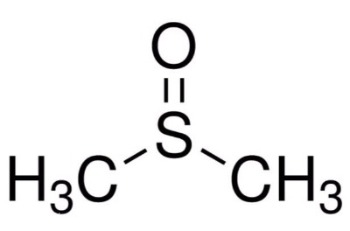
Physical properties: It is a colorless, odorless, transparent liquid at room temperature, has strong hygroscopicity, a freezing point of 18.55°C, and a density close to that of water, 1.100 g/mL;
Chemical properties: The molecular formula is (CH 3 ) 2 SO. Because of a hydrophilic sulfinyl group and two hydrophobic methyl groups in its structure, it is miscible with aqueous solutions and most organic solvents except petroleum ether; it can dissolve about 80% of compounds, most water-soluble compounds and fat-soluble compounds, so DMSO is also known as the "universal solvent".
History of DMSO
When DMSO was first discovered, it was called a "miracle drug" because of its wide range of uses. Scientists have conducted a lot of research, mainly including its anti-inflammatory, analgesic, diuretic, and sedative effects. In the early pharmaceutical industry, DMSO could be directly used as a raw material and carrier for certain drugs, and could also be used as a permeability protectant, platelet cryopreservative, etc.
However, in 1965, research on DMSO in the United States was suddenly stopped because a research discussion on DMSO attended by the FDA and some pharmaceutical companies pointed out that DMSO was found to affect the lens structure of many mammals, but no such changes were found in humans and primates.
How toxic is DMSO?
1. Cytotoxicity of DMSO: needs to be controlled to <0.1% (v/v)
(1) In 2008, Qi Weidong et al. found that when the culture medium contained 0.1%-0.25% (v/v) DMSO, there was no damage or effect on rat hair cells within 24 hours. However, when the DMSO content in the culture medium reached 0.5%-6%, hair cells were damaged and showed dose-dependent cell death [2].
(2) In 2014, He Bing et al. found that different concentrations of DMSO in the cell culture medium had a certain effect on the growth of rabbit chondrocytes cultured in vitro. When the concentration was 2.0% (v/v), it showed a strong inhibitory effect on chondrocytes, but within the concentration range of 0.1%-1.0%, it had little effect on cell growth [4].
2. Enzyme toxicity of DMSO: needs to be controlled to <0.1% (v/v)
(1) In 2011, Ramakrishna Nirogi et al. found that in a human liver microsome incubation experiment, DMSO at a concentration of more than 0.1% in the incubation system could inhibit the activity of CYP1A2 in human liver microsomes. However, 2% methanol or acetonitrile had no effect on the enzyme activity [5].
(2) In 2003, Masuhiro Nishimura et al. found that when compounds were administered to human hepatocytes, a final DMSO concentration of 0.1% or lower had no effect on the expression of the first phase drug metabolizing enzyme cytochrome P450 enzyme subtypes (CYPs), the second phase drug metabolizing enzyme glucuronyl transferase subtypes (UGTs) and the main transmembrane transporter ABC transporters in the hepatocytes. However, higher concentrations would change their expression [6].
3. Animal toxicity of DMSO
(1) Acute toxicity: refers to the rapid and severe poisoning reaction, including death, produced by the body after receiving a large dose of a drug at one time. Generally, the median lethal dose (LD50) of the drug can be used to assess the risk. The following results were obtained in various animal experiments:
The following table lists the DMSO half-lethal dose of each experimental animal under each administration method. From the table, we can see that the LD 50 of DMSO is actually relatively high. For example, the LD 50 of oral administration to mice is 16.5-24.6g/kg. The dosage in our mouse experiments is generally in mg/kg, so it is almost impossible to exceed this dose, which means that the overall toxicity to animals is not as strong as that to cells. The data provided by different laboratories may not be exactly the same, but they all confirm the low toxicity of DMSO to animals.
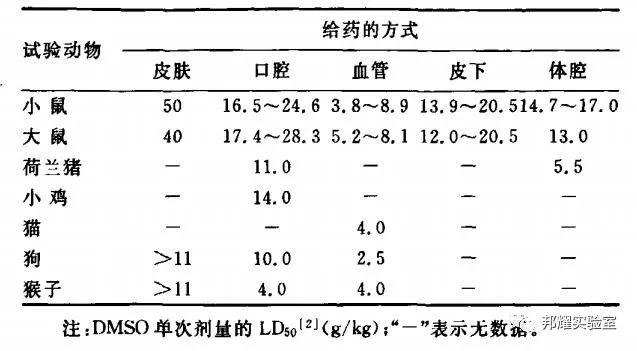
DMSO median lethal dose (g/kg)[3]
(2) Long-term toxicity: refers to the harmful effects of a drug on test animals when it is given to them at a certain level of dose for many consecutive days. The following results have been found in various animal experiments:
1. Experiments on dogs, pigs, rabbits and other animals at a dose of 5 g/kg.d of DMSO also showed that after a few months, the animals would experience changes in lens diopter rather than opacity. Moreover, this change was dose-dependent. As the DMSO dose decreased, the degree of change in lens diopter was very small. No such side effect has been found in primates (including humans) so far [7];
2. An experiment in which DMSO was administered to rhesus monkeys at a dose of 9 g/kg/d for 18 months showed that the monkeys had no obvious abnormalities or intolerance[8];
3. Experiments on male and female rats given DMSO at a dose of 1 g/kg 5 days/week for 12 months showed that the rats' tissues and organs, such as the brain, heart, intestines, reproductive system, and thyroid gland, were normal, with no obvious abnormalities or intolerance [ [9] ].
4. DMSO has a diuretic effect, but no kidney damage has been found in studies on humans and laboratory animals.
From the above toxicological data, we can see that compared with other safe and non-toxic solvents, although DMSO has certain toxicity, it also has its own unique properties. Before finding a better cell antifreeze agent and a "universal solvent" with higher flux, biological experiments and drug screening stages can also use DMSO reasonably to quickly produce correct experimental results without interference from reagent factors. Let's take a look at how to use DMSO correctly in experiments.
1. How to use DMSO correctly in cell experiments?
DMSO is mainly used in two aspects in cell experiments:
1. Cell cryopreservation agent DMSO is currently the best cell cryopreservation protective agent, but it has certain toxicity. Generally, the concentration is controlled below 10% of the final volume. For cells with weak tolerance, it can be reduced to below 10%, such as 8%. Note that dimethyl sulfoxide should be washed off as soon as possible during cell recovery, otherwise it will cause serious toxicity to the cells. Research results show that when the DMSO concentration in the culture medium is 10%, the cell growth inhibition rate is nearly 100%; at a concentration of 1%, the inhibition rate is 35%. Even at a concentration of 0.04%, DMSO has an adverse effect on cell growth [10].
2. DMSO, the solvent of the compound for cell administration, should be strictly controlled when dissolving the compound for cell administration: different cells may have different sensitivities to DMSO content, but it is now more acceptable that when DMSO is used to prepare compounds for cell administration, the final concentration of DMSO is controlled within 0.1%, which is considered to have no interference with cell experiments, that is, the volume of DMSO in 1ml of culture medium cannot exceed 1μl. If the volume is found to exceed this ratio, we can reduce the amount of DMSO used by increasing the drug concentration or using the aqueous phase multi-step dilution method.
2. How to use DMSO correctly in animal experiments?
The main application of DMSO in animal experiments is drug dissolution. In previous issues, we introduced the drug dissolution methods (see the link at the end of the article). However, when dissolving drugs, we must first consider the toxicity of the co-solvent, and then consider the solubility. If the drug can only be dissolved when the toxic ratio is exceeded, we must abandon this dissolution method.
From the above toxicity test data, we can see that the toxic side effects of DMSO on animals as a whole are much smaller than those on cells. Therefore, Li Ping et al. also believe that the amount of DMSO used in animal administration can account for 10%-20% of the total administration volume [11]. For example, when oral administration is used, the administration volume for mice is 10mL/kg. For a 20g mouse, our single administration volume is about 100-200μl. The DMSO volume must be controlled at 10%-20%, that is, 20-40μl.
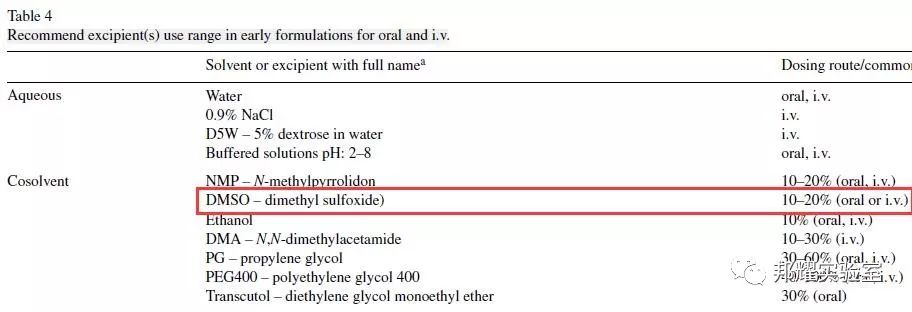
Recommended volume[11]
Note: The volume of DMSO used is for reference only. If the animal shows adverse symptoms, such as weight loss/decreased appetite, we should consider reducing the amount of DMSO used. The general principle is to minimize the use of DMSO.
Precautions in using DMSO
1. Avoid skin contact: Studies have found that DMSO has a small molecular weight and is easily absorbed through the skin. If the skin is in contact with DMSO for a long time, it will show a small local irritation reaction, such as local skin irritation, itching, and burning sensation. When conducting experiments, you can prepare 1%-5% ammonia water for use. If the skin is stained with it, it should be washed with a large amount of water and dilute ammonia water. At the same time, you should also avoid contact with dimethyl sulfoxide solutions containing other toxic substances, because dimethyl sulfoxide will penetrate into the skin and bring toxic substances into the skin under certain conditions.
2. Avoid inhaling DMSO: The most common symptoms of inhaling DMSO are nausea, vomiting, and the smell of garlic, onion, and oyster in the exhaled gas. Using high concentrations over a large area can affect nerve function and cause hemolysis. Avoid its volatilization when using it.
In summary, although DMSO has certain toxicity, it is not unusable; when we have not found a suitable alternative, it is still permitted to use DMSO in appropriate amounts in experiments to obtain research data.
References
[1] Brobyn R D. The human toxicology of dimethyl sulfoxide [J]. Annals of the New York Academy of Sciences, 1975, 243(1):497.
[2] Qi W, Ding D, Salvi R J. Cytotoxic effects of dimethyl sulphoxide (DMSO) on cochlear organotypic cultures[J]. Hearing Research, 2008, 236(1–2):52-60.
[3] Jia Guorong, Xie Bo. Current status of research on the safety of clinical application of dimethyl sulfoxide at home and abroad[J]. International Journal of Laboratory Medicine, 2010, 31(11):1284-1286.
[4] He Bing, Xie Xiaoyan, Zhang Feng, et al. Effects of different concentrations of dimethyl sulfoxide on the growth of rabbit chondrocytes[J]. Chinese Journal of Clinical Physicians: Electronic Edition, 2014, 8(9):79-82.
[5] Nirogi R, Kandikere V, Bhyrapuneni G, et al. Effect of dimethyl sulfoxide on in vitro cytochrome P4501A2 mediated phenacetin O-deethylation in human liver microsomes[J]. Drug Metabolism & Disposition the Biological Fate of Chemicals, 2011, 39 (11):2162.
[6] Nishimura M, Ueda N, Naito S. Effects of dimethyl sulfoxide on the gene induction of cytochrome P450 isoforms, UGT-dependent glucuronosyl transferase isoforms, and ABCB1 in primary culture of human hepatocytes.[J]. Biological & Pharmaceutical Bulletin, 2003, 26(7):1052-6.
[7] Surgeon J W. Subacute toxicity of intravenous dimethyl sulfoxide in rhesus monkeys[J]. Journal of Toxicology & Environmental Health, 1981, 7(1):49-57.
[8] Vogin EE, Carson S, Cannon G, et al. Chronic toxicity of DMSO in primates [J]. Toxicology & Applied Pharmacology, 1970, 16(3):606-12.
[9] Jacob SW, Rosenbaum E E. The toxicology of dimethyl sulfoxide(DMSO) [J]. Headache the Journal of Head & Face Pain, 1966, 6(3):127.
[10] Liu Er, Wang Jinbing. Cytotoxic effect of dimethyl sulfoxide as a cryoprotectant[J]. Chinese Journal of Preventive Veterinary Medicine, 1994(4):50-52.
[11] Li P, Zhao L. Developing early formulations: Practice and perspective [J]. International Journal of Pharmaceutics, 2007, 341(1):1-19.